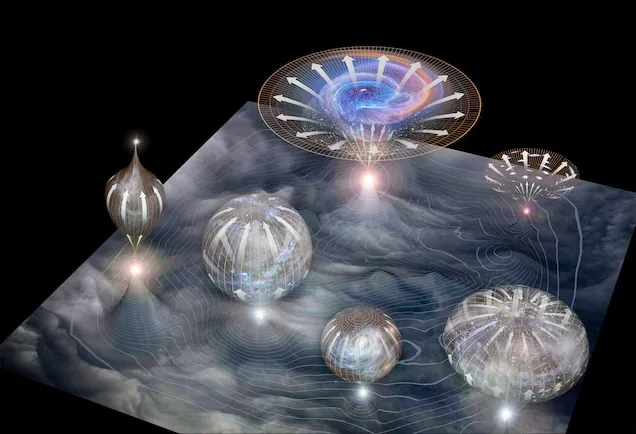
In a world filled with mysteries and unanswered questions, the concept of multiple universes has captivated the minds of scientists, philosophers, and dreamers alike. What if our reality is just one among countless others? What if there are parallel dimensions where different versions of ourselves exist?
Anúncios
These intriguing ideas have sparked scientific theories, philosophical debates, and endless possibilities. In this article, we will dive into the fascinating realm of multiple universes, exploring the scientific theories behind them, examining the possibilities they present, and pondering how the existence of these parallel realities challenges our perception of reality as we know it.
Get ready to unlock the doors to the unknown and embark on a mind-bending journey through the fascinating concept of multiple universes.
Anúncios
The concept of multiple universes explained
Multiple universes, also known as parallel universes or alternate realities, are a fascinating concept that has intrigued scientists and philosophers for centuries. The idea suggests that there may be countless other universes, each with its own set of physical laws, dimensions, and possibilities.
According to this theory, our universe is just one of an infinite number of universes that exist simultaneously. These universes may vary in their fundamental properties, such as the values of physical constants or the arrangement of matter and energy. In some universes, the laws of physics may be completely different from what we observe in our own.
Anúncios
The concept of multiple universes arises from various scientific theories, such as the multiverse theory and the string theory. The multiverse theory proposes that our universe is part of a larger “multiverse” that contains an ensemble of universes, each with its own unique properties.
On the other hand, the string theory suggests that there may be multiple dimensions beyond the three spatial dimensions we are familiar with.
Anúncios
While the existence of multiple universes is still a topic of debate and speculation, the concept has profound implications for our understanding of reality. It challenges our traditional notion of a single, unique universe and raises questions about the nature of existence, consciousness, and the fundamental laws of physics.
The scientific theories behind multiple universes
Multiple universes, also known as the multiverse, is a concept that has intrigued scientists and philosophers alike. It proposes the existence of parallel realities, each with its own set of physical laws and conditions. While the idea may seem far-fetched, there are several scientific theories that support the possibility of multiple universes.
One of the most well-known theories is the Many-Worlds Interpretation of quantum mechanics. According to this theory, every time a quantum event occurs, the universe splits into multiple branches, each representing a different outcome. This would mean that there are countless universes, each containing a different version of reality.
Another theory is the Bubble Universe theory, which suggests that our universe is just one of many bubbles in a vast cosmic foam. Each bubble universe exists within its own space-time continuum and can have different physical properties. These bubbles can collide or merge, creating new universes or causing changes in existing ones.
String theory, a branch of theoretical physics, also offers the possibility of multiple universes. According to this theory, the fundamental building blocks of the universe are tiny vibrating strings. These strings can vibrate in different ways, giving rise to different particles and forces. Each vibration pattern corresponds to a different universe, with its own set of physical laws.
While these theories remain speculative, they provide a fascinating glimpse into the possibilities of multiple universes. They challenge our understanding of reality and open up new avenues for exploration and discovery.
Exploring the possibilities of multiple universes
When contemplating the vastness of the universe, it is natural to wonder if we are alone or if there are other realms beyond our own. The concept of multiple universes opens up a world of possibilities, challenging our understanding of reality and pushing the boundaries of scientific exploration.
One theory suggests that there could be an infinite number of universes, each with its own set of physical laws and conditions. These parallel realities could exist alongside our own, with countless variations and possibilities playing out simultaneously.
Imagine a universe where gravity works differently, or where time flows backward. The existence of multiple universes presents the intriguing notion that anything we can imagine might actually exist somewhere in the vast cosmic landscape.
Exploring the possibilities of multiple universes not only expands our understanding of the cosmos but also raises profound philosophical questions. If there are infinite universes, does that mean there are infinite versions of ourselves? Are there alternate realities where different choices were made and different outcomes occurred?
While the idea of multiple universes may seem like science fiction, it is a topic of serious scientific inquiry. Physicists and cosmologists continue to explore this fascinating concept, using mathematical models and theoretical frameworks to unravel the mysteries of the multiverse.
Parallel realities and the existence of multiple universes
Parallel realities and the existence of multiple universes are fascinating concepts that have intrigued scientists and philosophers alike. The idea that there could be other universes, similar or completely different from our own, opens up a world of possibilities and challenges our understanding of reality.
According to some scientific theories, such as the multiverse theory, there could be an infinite number of universes coexisting alongside our own.
These parallel realities may have different physical laws, dimensions, or even alternate versions of ourselves. The existence of multiple universes suggests that our reality is just one among many, each with its own unique set of circumstances.
Exploring the possibilities of multiple universes can lead to mind-bending questions about the nature of existence. If there are other universes, what does that mean for our place in the cosmos? How do these parallel realities interact with each other? Can we ever travel between them?
These questions challenge our perception of reality and push the boundaries of scientific understanding. While the existence of multiple universes is still a topic of debate and exploration, it ignites our curiosity and encourages us to delve deeper into the mysteries of the cosmos.
How the idea of multiple universes challenges our perception of reality.
Our perception of reality is deeply rooted in our understanding of the world around us. We rely on our senses and our experiences to shape our view of what is real. However, the concept of multiple universes challenges this perception and forces us to question the very nature of reality itself.
Imagine a reality where every decision you make creates a new universe, branching off from the choices you didn’t make. In this scenario, there would be an infinite number of universes, each one representing a different outcome or possibility.
This idea challenges the notion of a singular reality and suggests that there are countless other versions of ourselves and the world we inhabit. It raises profound questions about free will, destiny, and the nature of existence.
Furthermore, the concept of multiple universes challenges our understanding of cause and effect. In a multiverse, the laws of physics may vary from one universe to another, leading to different outcomes and possibilities. This challenges our belief in a fixed and predictable universe, where every action has a corresponding reaction.
While the idea of multiple universes is still largely theoretical, it has captured the imagination of scientists, philosophers, and artists alike. It pushes the boundaries of our understanding and forces us to confront the limitations of our perception. It invites us to consider the vastness of the cosmos and the infinite possibilities that may exist beyond our current understanding.